
HAPPY 25th BIRTHDAY to the Burwood Centre!
In April 2025 the Burwood Centre is celebrating 25 years of offering independent multidisciplinary assessments to help support deaf children and young people.
Over the years we have supported roughly 1000 families of deaf children and young people by providing high quality, specialist assessments and reports. We’ve been privileged to have the input of some very brilliant professionals over the years including administrators, Advisory Teachers of the Deaf, audiologists, Educational Psychologists, and Specialist Speech and Language Therapists. If you have ever worked with us, then THANK YOU! If you have ever visited us, we hope that your child/young person is truly living their best life.
Language Assessments with Deaf Teenagers at the Burwood Centre
A Blog Post by Lorna Gravenstede, Highly Specialist Speech and Language Therapist, 24/9/2024
At the Burwood Centre I frequently provide assessments of language skills for deaf teenagers. This article gives you a little more information about language assessment in this age group and how things are done at the Burwood Centre.
Why Assess Language?
Typically, when I am asked to provide a language assessment for someone attending the Burwood Centre it is for one or more of these reasons:
- A parent wants to find out exactly how their child is functioning in comparison with his/her peers and discover whether their language skills are where they should be in terms of their age
- A parent wants to find out more about their young person’s relative strengths and weaknesses and discover if there are any particular difficulties with regard to language skills
- A parent wants to gain information/evidence on whether their child has the necessary language skills to access his/her school curriculum
- A parent has information on how a child was functioning in terms of language skills some time ago and wants to find out if progress has been made
- A parent would like advice on the next steps for the language development of their child and the level of support that their child needs to achieve this
In local settings, in addition to reasons given above, professionals also assess language to help guide them in terms of setting targets for next developmental steps, to help them target provision effectively and to inform their reports and monitor progress year on year.
What Skills are Assessed?
‘Language’ covers a very wide range of different sub-skills. Before we even unpick ‘language’ it is important to remember that young people may use different languages. Some teenagers only communicate using English, but others have an additional spoken language or may have British Sign Language (or indeed another world sign language) as their first or second language. Sometimes it is necessary to look at how a young person functions when using BSL versus sign supported English, versus spoken English, to answer questions about progress, next steps and provision.
No matter which language is being assessed, it is important to unpick some of the different skills within that language. These include:
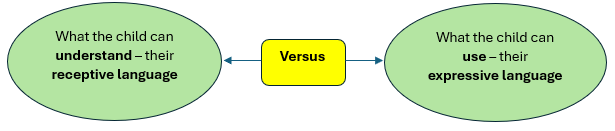
Within understanding and use of language we can think about:
- The child’s vocabulary – what range of individual words or signs can a child understand and use (this might not be the same for all young people so sometimes it is necessary to assess both understanding of vocabulary (individual words and signs) and ability to name words)?
- The child’s ability to use and understand grammar/structure. Again, understanding and use may differ and there are different published assessments that assess each of these areas of language.
- The child’s ability to understand longer utterances of language – so a whole paragraph or story. This skill involves a lot of other sub-skills – including the ability to perceive what has been said/signed, process it, understand individual words/signs, understand grammar/structure, and to be able to infer meaning and understand the whole message.
- The child’s ability to produce longer utterances of language – so a whole paragraph or story. This skill also involves a lot of other sub-skills – including being able to use needed individual words/signs, being able to structure sentences in terms of grammar and word order, being able to structure the whole meaning/story so that it makes logical sense and being able to understand what the listener already knows to ensure that relevant information is given. We can think about how well the child can tell stories – their narrative skills.
- Social use of language – or ‘pragmatic’ skills. This is all to do with how the child is able to use language in social real world settings.
When working at the Burwood Centre, I work alongside an Educational Psychologist and an Advisory Teacher of the Deaf. I choose any assessment tasks I carry out to fit in and complement what they are already doing. It makes sense not to over assess young people. For example, sometimes the Educational Psychology assessment might include a test where the child has to provide word definitions, so I would not carry out another of these. I am often able to observe the assessments that the other professionals do, so this gives me even more information.
How is Assessment Carried Out?
When working with teenagers, assessment typically involves the use of some formal/standardised assessments. Some assessment will also be carried out informally – it is possible to find out useful information about a young person’s language skills without using formal assessment. For example, observation can be made of their non-verbal interaction skills, their ability to understand conversational English or BSL (whichever is being used), their ability to form coherent phrases, the range of vocabulary in use, their ability to give relevant information, their ability to manage individual and small group interactions, their ability to understand jokes and hints, and their ability to provide information in a logical order. Informal observations are done on general discussions and conversations that need to happen anyway or that happen spontaneously. Equally, it might also be that a game or other task is used that elicits language and interaction, but which is more fun and not a standardised ‘test’ as such. For example, we might look at some riddles.
I do also usually carry out some formal/standardised assessments. These are tasks that assess a child/young person’s language skills that have previously been carried out on a wide range of other young people of their age so that it is possible to get a ‘score’ which can be compared to other young people using standard scores, percentile ranks or age equivalent scores. I use a wide range of published materials at the Burwood Centre – the assessments chosen depend upon:
- What I need to find out
- The skills of the young person (and what is needed to access the assessment)
- What has been done locally (it is not valid to repeat standardised tasks too frequently)
I have some assessments that are paper based and others on a system which uses two iPads. The iPad assessments are new. The iPads themselves were kindly donated by LifeLine4Kids and the assessment software on them by Stanton Ballard. I am so grateful to both charities for supporting our work in this way. The iPad system makes the assessments more fun for the young people who use them and they make scoring and analysis quicker for me. Different assessments are appropriate for different young people and tasks are chosen carefully. Examples of standardised tasks that a teenager may do include:
- Pointing to the correct picture out of a choice of different pictures to match a given word
- Pointing to a picture out of a choice of different pictures to match a whole sentence provided (the sentence may contain increasingly more tricky concepts or grammatical structure)
- Providing definitions for given words
- Naming a series of images
- Listening to a story and answering questions about it
- Making up sentences containing a given word or words
- Stating which two words go together out of a choice of four
- Solving short verbal problems
- Pointing to the correct picture that depicts the correct meaning of a phrase that needs to be interpreted non-literally, e.g. ‘my car has been boxed in’

Is it Stressful for the Young Person?
I always explain to the young person with whom I am working that they should not worry about finding any tasks difficult and that I have to keep going with the tasks until they find them hard no matter how well they do because otherwise it would not be possible to know just how good their skills are! Tasks that assess expressive language generally involve the young person giving me whatever language they can and so they tend not to be aware of getting things ‘wrong’. They are more aware of ‘not knowing’ when they have to point to an answer, and they know that they are unsure. I always provide a lot of reassurance that there is no passing or failing; that these are not like tests in school and that how they do will be used to help get them the right support….and praise them for their efforts in keeping going!
Some young people really enjoy language assessments – they like working one-to-one with an adult who is listening to them and showing what they can do. Lots of young people appreciate having the time to be able to talk to someone about what they are finding easy and difficult with regards to communication with others in school.
- HAPPY 25th BIRTHDAY to the Burwood Centre!In April 2025 the Burwood Centre is celebrating 25 years of offering independent multidisciplinary assessments to help support deaf children and young people. Over the years we have supported roughly 1000 families of deaf children and young people by providing high quality, specialist assessments and reports. We’ve been privileged to have the input of some very brilliant professionals over the years including Administrators, Advisory Teachers of the Deaf, Audiologists, Educational Psychologists, and Specialist…
- Quality Questionnaire 2022-23An anonymous questionnaire was sent to families who used the Burwood Centre between September 2022 and July 2023 in the hope that this would inform us how well we are able to meet the needs of those that come to the Burwood Centre and inform ways in which we can change so that we are even better. Roughly a third of the families who were sent surveys responded and we are extremely…
- Staff Changes at BurwoodOver the last six months we have seen some significant changes to staff at the Burwood Centre. First, last summer, one of our Educational Psychologists, Dr Rosie Thomasson, took up an exciting new position in Hong Kong. Rosie worked with us for many years and we all miss her and the amazing expertise she bought to the Burwood team. It was a privilege to be able to work alongside Rosie and I…
- CICS Article
 CICS magazine have kindly agreed that we can publish articles written for their magazine on our webiste. Here is a useful article from their July 2020 edition all about online assessments. The Covid pandemic meant that we had to adapt the way that we work. We are now seeing children in person again, but there are some families and situations where online assessment can work well and could be useful in the…
 - Welcome
 Welcome to our brand new Burwood Centre website. We hope that you can find all of the information you are seeking on here, but if not do get in touch with us by email or telephone (see the contact us section). The Burwood Centre is staffed by a very small, part time team and so it may take a few days to reply to emails. Generally, at the moment, someone is working…
 Burwood Centre